
When a tooth is damaged or missing, your dentist will often talk about two common solutions—crowns and bridges. Both are used to restore the look and function of your teeth. But they work in very different ways and are used in different situations. If you have been searching for a dentist near you to help with a damaged or missing tooth, understanding the difference between crowns and bridges will help you feel much more prepared for that conversation.
What Is a Dental Crown?
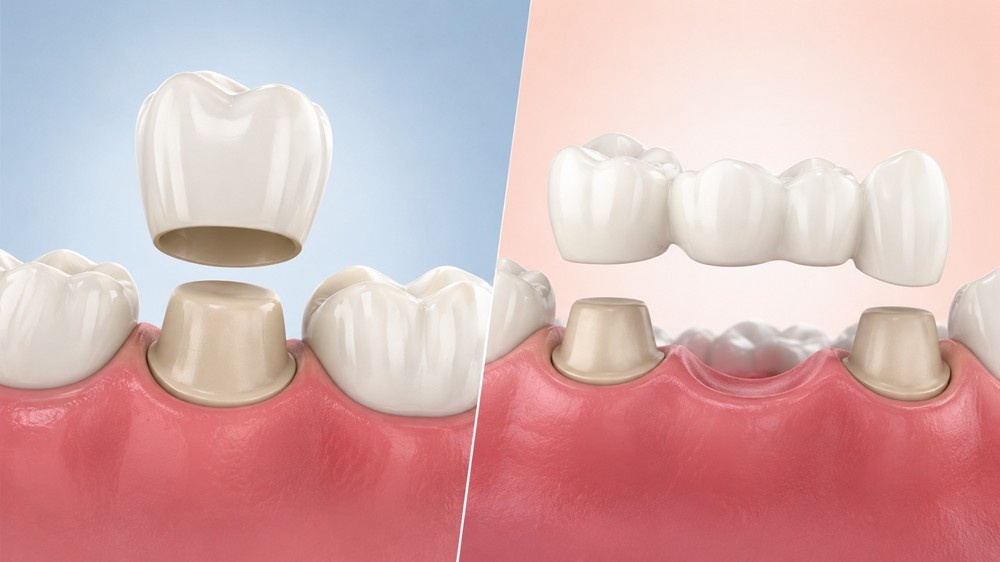
A dental crown is a cap that fits over a damaged tooth. It covers the entire visible part of the tooth—right down to the gum line.
Think of it like a protective helmet for your tooth. It holds the tooth together, restores its shape, and allows it to function normally again.
If you are looking into dental crowns near you, here is when a crown is typically recommended:
- A tooth is cracked or broken, but the root is still healthy
- A tooth has severe decay that a filling cannot fix
- A tooth has become weak after a root canal treatment
- A tooth is worn down from grinding
- A dental implant needs a visible tooth placed on top of it
- A tooth is badly shaped or discoloured and needs full coverage
A crown saves your natural tooth. It gives it new strength and a natural appearance—without removing it.
What Is a Dental Bridge?
A dental bridge does something different. It replaces a tooth that is already missing.
A bridge literally bridges the gap left by a missing tooth. It consists of two crowns on either side of the gap—placed on the healthy neighbouring teeth—with an artificial tooth in the middle suspended between them.
The neighbouring teeth that hold the bridge in place are called abutment teeth. The artificial tooth in the middle is called a pontic.
If you are exploring dental bridges near you, a bridge is typically recommended when:
- One or more teeth are missing in a row
- The teeth on either side of the gap are healthy enough to support a bridge
- A dental implant is not a preferred or suitable option
- The gap is causing difficulty with chewing or speaking
- Neighbouring teeth are beginning to shift into the empty space
A bridge restores the appearance of your smile and the function of your bite — without the need for surgery.
Crown vs. Bridge—What Is the Key Difference?
The simplest way to understand the difference is this:
- A crown is used when the tooth is still there, but damaged
- A bridge is used when the tooth is completely gone
A crown works alone—it sits on top of your existing tooth. A bridge works as a connected unit—it relies on neighbouring teeth for support and fills the space where a tooth is missing.
Here is a clear side-by-side comparison:
|
Factor |
Dental Crown |
Dental Bridge |
|
Purpose |
Restores a damaged tooth | Replaces a missing tooth |
|
Number of teeth involved |
One tooth |
Three or more teeth |
|
Natural tooth present |
Yes—the tooth still exists |
No—the tooth is gone |
|
Relies on neighbouring teeth |
No |
Yes—for support |
|
Surgery involved |
No |
No |
|
Preserves natural tooth |
Yes |
Neighbouring teeth are modified |
|
Longevity |
10 to 15 years with care |
10 to 15 years with care |
| Best suited for | Cracked, decayed, or weakened teeth |
Single or multiple missing teeth |
What Materials Are Used for Crowns and Bridges?
Both crowns and bridges can be made from several different materials. Your dentist will recommend the best option based on the location of the tooth and your personal preferences.
Common materials include:
- Porcelain or ceramic — most natural-looking, ideal for front teeth
- Porcelain fused to metal — strong and natural looking, suitable for back teeth
- Zirconia — very strong and natural in appearance, increasingly popular
- Gold or metal alloys — extremely durable, sometimes used for back teeth
Each material has its own strengths. Your dentist will explain which option suits your situation best during your consultation.
What Does the Process Look Like?
Getting a Dental Crown
The crown process usually takes two appointments:
- First appointment—the tooth is examined, shaped, and an impression or digital scan is taken. A temporary crown is placed while the permanent one is made.
- Second appointment—the permanent crown is checked for fit and colour, then bonded securely onto the tooth.
Getting a Dental Bridge
The bridge process also typically takes two appointments:
- First appointment — the two abutment teeth on either side of the gap are prepared by removing a small amount of enamel. An impression is taken, and a temporary bridge is placed.
- Second appointment — the permanent bridge is checked for fit and then bonded into place.
Both procedures are carried out under local anaesthesia. Most patients feel comfortable throughout and experience only mild sensitivity afterward.
Are There Alternatives to Crowns and Bridges?
Yes—and it is worth knowing your options before making a decision.
For a damaged tooth, alternatives to a crown may include:
- A large filling — suitable for less severe damage
- Dental bonding — for minor chips or cracks
- Inlays or onlays — for moderate decay that does not require full coverage
For a missing tooth, alternatives to a bridge include:
- Dental implants—a titanium post placed into the jawbone, topped with a crown. Implants do not require neighbouring teeth to be modified and are considered the most long-term solution.
- Partial dentures—a removable option for replacing one or more missing teeth
Each option has its advantages. Your dentist will help you weigh them based on your oral health, budget, and personal goals.
How to Care for Crowns and Bridges
Both crowns and bridges are designed to be durable. But they still need proper care to last as long as possible.
Here is how to look after them:
- Brush twice a day with a soft-bristle toothbrush and fluoride toothpaste
- Floss carefully around crowns and under bridges—your dentist may recommend a floss threader or interdental brush
- Avoid biting on very hard foods like ice, hard sweets, or crusty bread with your crown or bridge
- Use a night guard if you grind your teeth
- Have your teeth professionally cleaned and examined on a routine basis
- Let your dentist know about tooth discomfort, tightness, or sensitivity immediately
It’s a simple part of a few small daily routines that protect your investment.
Who Is a Good Candidate for a Crown or Bridge?
For a Crown, you are likely a good candidate if you:
- Have a tooth that is cracked, heavily decayed, or weakened
- Have recently completed root canal treatment
- Have a tooth that is badly shaped or discoloured
For a Bridge, you are likely a good candidate if you:
- Have one or more missing teeth with healthy teeth on either side
- Have enough bone and gum tissue to support the bridge
- Do not have active gum disease or untreated decay
- Want a fixed, non-removable tooth replacement option
In both cases, a thorough dental assessment will confirm whether you are suitable and what the best approach is for your specific situation.
Restoring Your Smile Is Simpler Than You Think
Whether you need to repair a damaged tooth or replace a missing one, crowns and bridges are proven, reliable solutions that can restore both the look and function of your smile. Understanding the difference between them puts you in a much better position to have an informed conversation with your dentist.
Here at Jasper Ave Dental Choice, we want you to feel relaxed and secure, always. We are here to examine your dental health, answer any questions about your treatment options, and make informed decisions about the care you choose for your health. Let us give you a consultation today and start your journey to a full and healthy smile.
FAQs
Q1. Do crowns and bridges feel like natural teeth?
Crowns and bridges fit and feel almost identical to natural teeth once they are placed. Most people adapt to them very rapidly.
Q2. How long will crowns and bridges last?
They can last from 10 to 15 years or more if properly cared for and regularly checked by your dentist.
Q3. Is getting a crown or bridge painful?
Both procedures are done under local anesthesia, so you should not feel pain during treatment. Some mild sensitivity or soreness afterward is normal and usually settles within a few days.
Q4. Can a bridge be removed once it is placed?
No — a dental bridge is permanently bonded in place and is not designed to be removed. Only your dentist can remove it if replacement is ever needed.